The Friends of the Florissant Fossil Beds

July 30, 2007

First World Ranger Day

Filed under: Conservation, Events, People — The Friends of the Florissant Fossil Beds, Inc. @ 12:00 pm

Ranger Harv Burman and visitors on the Ponderosa Loop Trail

Ranger Harv Burman leads a hike at the opening of the Ponderosa Loop Trail, October 2006.
At the International Ranger Federation Scotland World Congress of Rangers in 2006, delegates decided that July 31 of each year, beginning in 2007, would be a day dedicated to rangers. This first World Ranger Day will fall on the 15th anniversary of the founding of IRF on July 31, 1992. World Ranger Day recognizes the work of rangers in preserving the world’s protected areas.World Ranger Day will be marked by the international premier of the documentary The Thin Green Line, which chronicles the exciting and sometimes dangerous work of rangers around the world. For more information, visit the documentary’s website at The Thin Green Line. To RSVP for the Colorado Springs premiere, go here.

July 28, 2007

Monument paleontologist to speak about Peruvian fossil conservation

Filed under: Conservation, Education, Events, Lectures, Paleontology, Research — The Friends of the Florissant Fossil Beds, Inc. @ 12:00 pm

View of petrified logs at Piedra Chamana

Petrified log at Piedra ChamanaFlorissant Fossil Beds National Monument Paleontologist Dr. Herb Meyer will be giving a Curator’s Lunchtime Lecture at the Denver Museum of Nature & Science on August 1. This talk will cover the work Meyer and others have been doing to assist the citizens of Sexi, Peru, in conserving and developing a nearby Middle Eocene fossil forest, Piedra Chamana. Come learn about this developing partnership and research on the fossil forest and see beautiful photographs of a remote part of Peru!

Cross-section of petrified log at Piedra ChamanaWhat: Exploration and Conservation of the Sexi Petrified Forest in the Andes of Northern Peru
Who: Dr. Herb Meyer, Florissant Fossil Beds National Monument Paleontologist and DMNS Earth Sciences Research Associate
When: Wednesday, August 1, 12:15–1:15 p.m.
Where: Ricketson Auditorium, Denver Museum of Nature & Science
Cost: $5, free for DMNS members
Reservations: (303) 322-7009 or 1-800-925-2250

NO FOOD ALLOWED.

Photo Credits: Herb Meyer

July 22, 2007

Ponderosa Loop Trail temporarily closed

Filed under: Interpretation, Park Changes, Trails, Wildlife — The Friends of the Florissant Fossil Beds, Inc. @ 9:00 am

The Ponderosa Loop Trail will be temporarily closed for repairs, beginning Monday, July 23.  Repairs should take about a week.

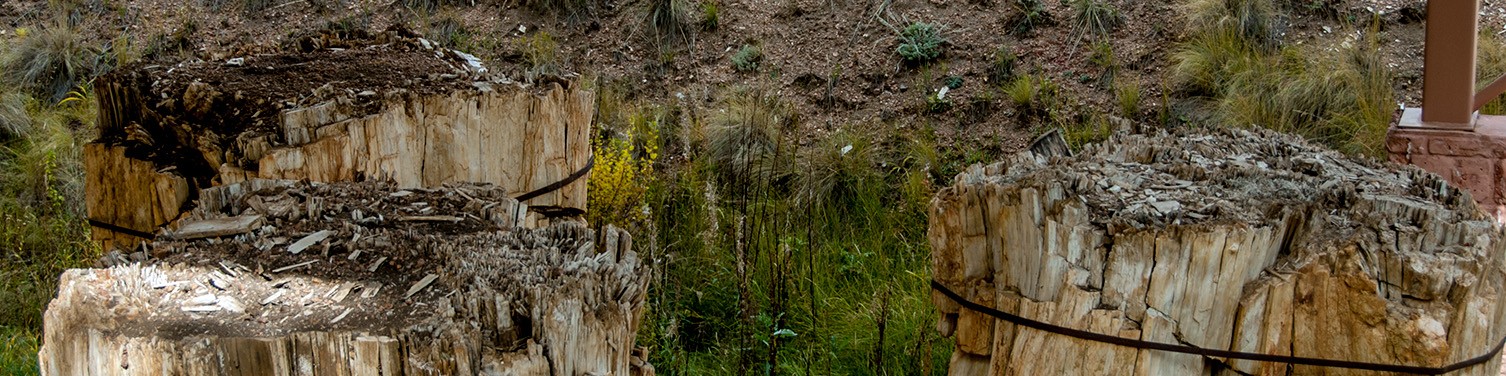
 The Ponderosa Loop is a 1-mile, wheelchair- and walker-accessible mountain trail through ponderosa and aspen forest.  It is a short, easy trail appropriate for families with small children and people with time constraints.  Guided booklets are available at the Visitor Center.  In addition to learning about the ponderosa ecosystem, hikers can see several petrified redwood stumps along the trail and may spot wildlife, including Abert’s squirrels, nuthatches, and northern flickers.  If you haven’t already hiked this trail, be sure to visit after maintenance is completed.

 Edited to add: The Ponderosa Loop is expected to remain closed through mid-September.

July 21, 2007

Species Spotlight: Northern Flicker

Filed under: Biology, Ecology, Species Spotlight — The Friends of the Florissant Fossil Beds, Inc. @ 4:00 am

Male northern flicker

The northern flicker (Colaptes auratus) is one of the most commonly-seen members of the woodpecker family in Colorado. Flickers are unmistakable, with their large size (12-14 inches tall) and dramatic coloration, and they are the only woodpecker that regularly feeds on the ground.

femaleflicker.jpgRed-shafted flickers are the color variety most commonly seen in the western United States, named for the bright red or red-orange shafts of their wing feathers. In flight, the undersides of their wings are visible as a flash of red. Males and females have similar coloration, but males can be identified by their red cheek patches or “moustaches” (above). Like other woodpeckers, the primary food of the flicker is insects, although they will also eat fruits, seeds, and nuts.

Northern-dwelling flickers migrate in winter, unlike most other woodpecker species.  The red-shafted flicker also interbreeds with the yellow-shafted flicker where their ranges overlap.  Although formerly thought to be separate species, the red-shafted flicker is now considered a subspecies (Colaptes auratus cafer).

As you walk around Florissant Fossil Beds National Monument, watch for the undulating flight and red wings of the northern flicker, and listen for loud drumming or a “laughing” ki ki ki ki call.

 At the nearby Manitou Experimental Forest, abandoned flicker nesting cavities serve as nesting cavities for the sensitive flammulated owl (Otus flammeolus).

-Melissa Barton

Photo Credits: Elaine R. Wilson (male) & Alan D. Wilson (female)/NaturesPicsOnline.com (Creative Commons Attribution ShareAlike 2.5 license). Both photos taken in Oregon.

July 18, 2007

Junior Ranger Program News

Filed under: Activities, Education, Events, For Kids, News, Park Changes, People — The Friends of the Florissant Fossil Beds, Inc. @ 9:00 am

Junior Ranger Program now free

In honor of National Park Week (April 22-29) and the first National Junior Ranger Day (April 27), Florissant Fossil Beds National Monument announced that its Junior Ranger Program will now be free. This decision has been made possible with assistance from the Friends and the Rocky Mountain Nature Association.

The park’s Junior Ranger Program consists of a book of activities to complete, after which the participant can choose either a Junior Ranger badge or a patch showing a paper wasp, possibly the park’s most iconic fossil.

Since the park is installing new exhibits, the Junior Ranger booklet will need to be updated. Last summer’s Teacher-Ranger-Teacher, Greg Spalding, has been hired to revise and coordinate the Junior Ranger Program this summer.

(more…)

Older Posts »

Powered by WordPress