The Friends of the Florissant Fossil Beds

May 25, 2008

Last of new exhibits installed

Filed under: Activities, Education, Exhibits, For Kids, Geology, Interpretation, Paleontology, Science — The Friends of the Florissant Fossil Beds, Inc. @ 12:00 pm

New exhibit panels

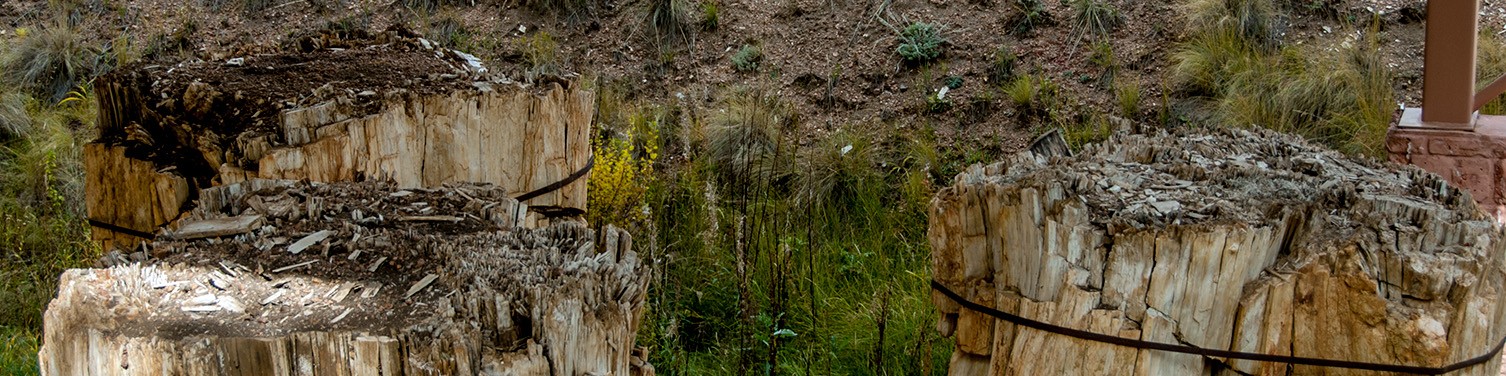
The last of the new Visitor Center exhibits at Florissant Fossil Beds National Monument have been installed. They include a diagram of a stratigraphic column showing the different types of rocks in the park, touchable samples of rock and fossil wood, and an changing board showcasing currently research at the park and partnership projects like the conservation of the Sexi Petrified Forest in Peru.

These exhibits greatly enhance the park’s ability to educate visitors, and display some of the park’s most spectacular fossil specimens along with hands-on activities for kids. The free Junior Ranger Program is a great complement to the new exhibits.

-Melissa Barton

Related Stories

April 7, 2008

“Paleontology of the Upper Eocene Florissant Formation, Colorado” available from GSA bookstore

Filed under: Geology, History, Paleontology, Research, Science — The Friends of the Florissant Fossil Beds, Inc. @ 7:41 pm

Cover of Paleontology of the Upper Eocene Florissant Formation, Colorado

Paleontology of the Upper Eocene Florissant Formation, Colorado (ISBN 9780813724355), a Geological Society of America special paper, is now available from the GSA Bookstore ($42 GSA members, $60 nonmembers).

This 177-page volume, edited by Florissant Fossil Beds National Monument paleontologist Dr. Herbert W. Meyer and University of Colorado Museum of Natural History professor Dr. Dena M. Smith, collects 11 papers on research, resource management, and history at the Fossil Beds.

These papers include, among others a history of the paleontological study of the site; new models for the role of biofilms in fossil preservation; plant-insect associations during the Eocene; a summary of the mammalian fauna; the mineralogical preservation of the fossil woods and conservation strategies for the petrified forest; and the development of a new database to compile a complete inventory of the fossils and their taxonomy.

While aimed at a scientific audience, this volume is a must-have for the library of any serious enthusiast of the Florissant fossils.

October 21, 2007

Florissant Research at the Geological Society of America Annual Meeting

Filed under: Education, Geology, Paleontology, Research, Science — The Friends of the Florissant Fossil Beds, Inc. @ 12:00 pm

This year’s Geological Society of America Annual Meeting will be held in Denver October 28-31. This is one of the largest geoscience meetings and an important place to hear about new research and new trends in geoscience education, forensic science, and other related fields.

Park Paleontologist Dr. Herb Meyer will be presenting an hour-long talk about fossil leaves and paleoelevation at a special session sponsored by the Mineralogical Society of America and The Geochemical Society on Friday, October 26 (the session runs through October 27). An associated Reviews in Mineralogy and Geochemistry volume will also be published. For more information, visit the MSA website.

There will also be three presentations during technical sessions that touch upon Florissant.

THE FRIENDS OF THE FLORISSANT FOSSIL BEDS: FACILITATING COLLABORATIVE EFFORTS IN INFORMAL GEOSCIENCE EDUCATION OUTREACH, by Steven Wade Veatch, Herbert W. Meyer, and Donald A.K. Miranda.

Friends president Steve Veatch will present about the geoscience education and outreach efforts of the Friends, including the summer seminar series; funding and research support for interns, students, and scientists; and our new partnership with a Peruvian fossil conservation organization similar to the Friends.

THE FATE OF AIRFALL VOLCANIC ASH IN LARGE AND SMALL LACUSTRINE SYSTEMS: ASH STRATINOMY OF THE EOCENE GREEN RIVER AND FLORISSANT FORMATIONS, by Charles Ver Straeten.

Dr. Charles Ver Straeten, who conducted preliminary fieldwork at the park this summer, will present an update on his work studying ash preservation in the Green River and Florissant Formations.

USING TRADITIONAL FIELD METHODS TO HELP STUDENTS IMPROVE OBSERVATIONAL SKILLS AND DEVELOP EVIDENCE-BASED INTERPRETATIONS, by James O. Puckett and Neil H. Suneson.

Other institutions, such as Oklahoma State University, also recognize the value of the Florissant area for geological education:

“The summer field camp experience provides many students with their best opportunity to observe geologic features whose spatial distribution, size, and shape will impact the students’ future careers as geoscientists. Oklahoma State University’s geology field camp near Canon City, Colorado focuses on time-tested traditional methods of geological mapping and field work. [...] The course includes field trips to the Cripple Creek and Leadville mining districts, Florissant/Guffey volcano area, Pikes Peak batholith, and Spanish Peaks radial dike swarm. The field trips emphasize aspects of geology that are not stressed in the field exercises.”

-Melissa Barton

August 31, 2007

Driving the Gold Belt Byway: Indian Springs Trace Fossil Site and Phantom Canyon (Stops 19-21)

Filed under: Activities, Biology, Geology, Gold Belt Byway, History, Paleontology, Science, Travel — The Friends of the Florissant Fossil Beds, Inc. @ 12:00 pm

Our last major stop for the day on the Gold Belt Byway was Indian Springs Ranch, a ranch and campsite owned by the Thorson Family. The Indian Springs Trace Fossil Site is a National Natural Landmark (NNL) protected by the federal government, but it is owned by the Thorson Family and you must have permission and be accompanied by a family member to visit the site. Tours may be arranged by calling ahead.

Photo of chinchweed flowersCarly Thorson, who led our tour, is very knowledgable about the many plants of the ranch, as well as its history. The flower to the left is chinchweed (Pectis papposa), a lemony-scented plant with several medicinal uses. We also saw a petroglyph and some historical sites, including the cabin used by Wild Bill McKinney of Quantrill’s Raiders.

Photo of National Natural Landmark markerThe Middle Ordovician (c. 450 million years old) trace fossils were found by Thorson’s father, Bennie C. Thorson, who worked the site for five field seasons with now-retired Colorado College professor William A. Fischer. The site was designated as an NNL in 1979. The voluntary NNL program, administered by the National Park Service, provides a way to recognize and protect important natural resources on any type of land, including private, local, municipal, state, and federal. Not all NNLs are open to the public, and many others require landowner permission to visit.

Photo of Indian Springs Trace Fossil SiteThe Indian Springs Trace Fossil Site consists of a shallow excavation exposing a single bed of the Harding Sandstone, representing an “instant” in geologic time. The quarry is 16-18 feet above the base of the Harding. Much of the overlying sandstone has been eroded at this locality. The Thorsons keep the site covered to protect the exposed trace fossils, which remain in situ according to family policy.

Photo of sea scorpion trackBody fossils are rare in the Harding, including at Indian Springs, but trace fossils are abundant. Bony plates from ostracoderms (armored fish) and conodont elements are found there, but the site’s primary significance lies in its spectacular trace fossils from various animals moving across the Ordovician seafloor. At right, you can see a track left by a sea scorpion (eurypterid).

Photo of ostracoderm feeding traceOstracoderms were some of the earliest vertebrates. They lacked jaws, but were covered with bony plates, and were also the first organisms to use gills exclusively for respiration. Ostracoderms were bottom-feeders and probably relatively slow-moving. Here you can see a feeding trail of an ostracoderm. The close spacing of the feeding marks indicates that food was abundant on the Ordovician seafloor.

Photo of horseshoe crab feeding traceTracks of several species of horseshoe crabs are quite common. The feeding traces typically curve either left or right according to the species. Horseshoe crabs are not actually crabs–they are more closely related to sea scorpions, and distantly related to the spiders–and they have evolved little since they first appeared in the fossil record. They are tolerant of harsh environments and protected by their sturdy shell.

Photo of ostracoderm feeding and predator attack tracesThis trace fossil shows an abruptly ended ostracoderm feeding trail, as the fish became a meal for a predator. The preservation of interactions like these is one reason the Indian Springs fossil site is so important. Other trace fossils at this site include tracks from trilobites, merostomes, and polychaete worms.

After Indian Springs, we drove back through Phantom Canyon (Stops 19-20), the location of several historical railroad sites, as well as more outcrops of Precambrian granodioriate and metamorphic schist and quartzite. We didn’t manage all of the stops on the Gold Belt Byway–that would take at least two days–but we had a great field trip.

-Melissa Barton

Photo Credits: Melissa Barton

Geologic Guidebook to the Gold Belt Byway, Colorado, by Thomas W. Henry, Emmett Evanoff, Daniel A. Grenard, Herbert W. Meyer, and David M. Vardiman (Gold Belt Tour Scenic and Historic Byway Association, 2004), is available at the Florissant Fossil Beds National Monument Visitor Center for $19.95 plus tax.

More Gold Belt Byway Posts:

August 29, 2007

Driving the Gold Belt Byway: Garden Park and Skyline Drive Fossil Sites (Stops 12, 14-16)

Filed under: Activities, Geology, Gold Belt Byway, Paleontology, Science, Travel — The Friends of the Florissant Fossil Beds, Inc. @ 12:00 pm

copesnipple.jpgOur first stop in the Garden Park Fossil Area was a view of Edward Drinker Cope’s quarries (Stop 16). Cope (1940-1897) was a well-known and notorious paleontologist, as much for his sometimes vicious rivalry with Othniel Charles Marsh for new dinosaur discoveries, which came to be known as the “Bone Wars.” The pointed hill in the middle of the photo at left is Cope’s Nipple, and the two buttes flanking it are known as the Forts. Orem Lucas collected dinosaur fossils for Cope from near the base of the Nipple. These fossils from the Late Jurassic Morrison Formation (about 155-147 million years old) included the first specimen of Camarasaurus supremus, a short-nosed sauropod.

Marsh-Felch QuarryWe then visited the nearby Marsh-Felch Quarry (Stop 15), where the first specimens of several well-known dinosaurs, including Allosaurus, Ceratosaurus, Diplodocus, and Stegosaurus were collected, as well as the first Jurassic mammals collected in North America. Marshall and Henry Felch excavated this quarry for Marsh, and their correspondence and other historical information (and lesson plans for teachers) can be found at Hands on the Land’s Marsh-Felch Quarry website.

sauropodrib.jpgThe Felch brothers completed their excavations in 1888, and the Carnegie Museum of Natural History worked the quarry in 1900 and 1901. Although fossils are generally not visible on the surface, the photo at left shows the cast of a removed dinosaur rib, and there are a few sauropod tracks as well.

After visiting the Marsh-Felch quarry, we stopped by the Bureau of Land Management picnic area across Fourmile Creek from the Cleveland Quarry (Stop 14), worked in 1954 and 1957 by Edwin Delfts for the Cleveland Museum of Natural History. This area produced one of the most complete known specimens of the long-necked sauropod Haplocanthus delfsi, as well as fossil eggs that may be from the small dinosaur Othnielia.

dinotrack2.jpgWe didn’t have time to visit Dinosaur Depot (Stop 11) in Cañon City, where casts of some of the famous Garden Park dinosaurs, a 20-foot-long fossil tree, an active paleontology preparation lab, and other exhibits can be viewed. Instead we continued to Skyline Drive (Stop 12), where dinosaur trackways are preserved in the Early Cretaceous Dakota Sandstone (approximately 100 million years old), which overlies the Morrison.

dinotrack1.jpgMost of the Skyline Drive tracks, carefully exposed by volunteers with the Garden Park Paleontology Society, were made by ankylosaurs, a type of armored herbivore. In the image at left, you can see the lone therapod (carnivorous dinosaur) track overlapping one of the ankylosaur tracks.

dinotrack3.jpgAt right, paleontology intern Eva Lyon looks at the dinosaur trackway. Other fossils found here include tree roots and branches, fossil shrimp burrows, and other trace fossils. For more information about the trackway, visit Dinosaur Depot’s Skyline Drive page. Dinosaur Depot also runs educational tours of the Garden Park Fossil Area and Skyline Drive.

After Skyline Drive, we continued on to the Indian Springs Trace Fossil Site, a much earlier (about 450 million years old) marine trace fossil site.

-Melissa Barton

Photo Credits: Melissa Barton

Geologic Guidebook to the Gold Belt Byway, Colorado, by Thomas W. Henry, Emmett Evanoff, Daniel A. Grenard, Herbert W. Meyer, and David M. Vardiman (Gold Belt Tour Scenic and Historic Byway Association, 2004), is available at the Florissant Fossil Beds National Monument Visitor Center for $19.95 plus tax.

More Gold Belt Byway Posts:

Older Posts »

Powered by WordPress