The Friends of the Florissant Fossil Beds

July 27, 2008

Tickets for Richard Louv presentation available August 1

Filed under: Activities, Conservation, Education, Events, For Kids, For Teachers, Lectures, People — The Friends of the Florissant Fossil Beds, Inc. @ 12:00 pm

Last Child in the Woods book coverThanks to partnerships with the Catamount Institute and other local organization, Colorado residents will have the chance to hear Richard Louv, author of the award-winning book Last Child in the Woods: Saving Our Children from Nature-Deficit Disorder and recipient of the 2008 Audubon Medal, speak at the Pikes Peak Center this October.

Tickets go on sale August 1 at 10 a.m. This event is part of No Child Left Inside Weekend, a collaboration between many Pikes Peak area parks and nature centers. For more information about scheduled activities and events as it becomes available, visit Florissant Fossil Beds National Monument’s No Child Left Inside website.

Who: Richard Louv, author of Last Child in the Woods: Saving Our Children from Nature-Deficit Disorder
When: 7:00 p.m., Friday, October 3, 2008 (doors open at 5:30 p.m. for exhibits)
Where: Pikes Peak Center, Colorado Springs, CO

For more information, email info@catamountinstitute.org or call 719-471-0910, Ext. 106. Tickets go on sale August 1 at 10 a.m. Adults $10, Educators $7, Students $5. Contact Tickets West at 719-520-SHOW.

March 25, 2008

Richard Louv to speak in Colorado Springs

Filed under: Activities, Education, Events, For Kids, Lectures, Partnerships — The Friends of the Florissant Fossil Beds, Inc. @ 4:44 pm

by Sally McCracken Maertens, Friends Vice President

Hardly a day goes by that I don’t pick up a magazine, a newspaper, a professional journal, or a newsletter and see a reference to getting our kids outside again. So many of us “older fossils” were raised outdoors. It is sad to hear kids say that they would rather be inside with video games and computers.

Richard Louv’s book Last Child in the Woods: Saving Our Children from Nature-Deficit Disorder has made us sit up and take notice. The National Park Service, the U.S. Forest Service, state parks, health organizations, environmental agencies, and educational institutions have all begun to work on initiatives to “leave no child inside.”

The Friends of the Florissant Fossil Beds have finally been able to confirm a speaking engagement date with Richard Louv. Mark Friday, October 3, 2008, on your calendars! A weekend of outdoor activities is being planned by a core group of stakeholders, including Colorado College, the Catamount Institute, Colorado Alliance for Environmental Education, the Sierra Club and the School in the Woods. We are all very excited. Credit will be available for teachers.

Once the basics are accomplished by the planning team, more information will be available to our members. We hope that the weekend of October 3-5 will be a great event for the people of El Paso and Teller County. We will be looking for volunteers to help with various aspects of the event. If you would like to help, please contact Sally McCracken Maertens at smaertens@fossilbeds.org.

February 19, 2008

Exceptional diversity of fossil algae at Florissant

Filed under: Ecology, Events, Lectures, Paleontology, Research, Science — The Friends of the Florissant Fossil Beds, Inc. @ 11:40 pm

Modern marine diatoms

The ancestors of these modern marine diatoms coexisted with the dinosaurs. Photo Credit: Dr. Neil Sullivan, University of Southern California/NOAA

University of Colorado at Boulder graduate student Mary Ellen Benson, M.S., gave a talk about her doctoral research at the University of Colorado Museum of Natural History (UCM) on February 7.

Benson’s talk, titled “Exceptional Diversity of Late Eocene Freshwater Diatoms from the Florissant Formation, Teller County, Colorado,” summarized some of her work to date on the previously unstudied fossil diatoms of the Florissant Formation.

Diatoms are microscopic, single-celled, golden-brown algae with hard silica shells (frustules). These shells are extremely tiny, only 10-100 microns (1 micron = 1/1000 millimeter). Scientists use the shapes, sizes, and ornamentation of the frustules to identify diatom species. Diatoms can be divided into two major groups according to shape, centric (round) and pennate (elongated).

Although marine diatoms are known as far back as the Jurassic Period (200 million years ago), confirmed reports of freshwater diatoms in North America are much more recent. The diatoms of the Florissant Formation represent one of the earliest occurrences of freshwater diatoms in North America.

The Scudder Pit Interpretive SiteFossil diatoms are most abundant in thin “paper shale” layers within the Florissant Formation, such as those found at the Scudder Pit Interpretive Site. Photo Credit: Melissa Barton

Benson’s research, which is partially funded by visitor fees from the Federal Lands Recreation Enhancement Act (formerly Fee Demo Program), is currently focused on identifying the fossil diatoms and comparing the Florissant assemblage to other Eocene assemblages from western North America. Additional funding sources include the Paleontological Society, Walker Van Riper Fund at UCM, Evolving Earth Foundation, Colorado Scientific Society, Colorado Mountain Club, and the Sam Van Landingham Fellowship at the California Academy of Sciences.

In order to examine the diatoms with a light microscope, Benson must break up the matrix of the rock, make a slurry, dry the slurry on cover slips, and then mount the slips on slides. However, many important identifying characteristics cannot be seen without the higher-powered scanning electron microscope (SEM). Taking a good micrograph is difficult and time-consuming.

SEM micrographs of modern diatomsThese SEM micrographs of modern diatoms show the whole frustule of a centric diatom (A), two whole pennate diatom frustules (B), a single valve of a centric diatom (C), and another centric diatom frustule (D). Relatives of some of these diatoms are known from the fossil record. Photo Credit: Mary Ann Tiffany, San Diego State University

The Florissant diatoms are extremely diverse compared to other Eocene sites, Benson has found. Many of the Florissant genera have not been recorded in other Eocene or earlier deposits. Benson hopes to find and describe new species within these genera.

“Although the diatoms are relatively well-preserved, they are not as well-preserved [as the plant and insect fossils of Florissant],” Benson said at the talk, “so their claim to fame will be their diversity, not their preservation.”

Since diatom frustules can dissolve in alkaline water, they are not always preserved in lake deposits, even if diatoms lived in the lake. Diatomaceous sediments can also be replaced by chert if additional silica is introduced after burial.

Florissant presents an exceptional opportunity for scientists like Benson to study the evolutionary history of diatoms and what diatoms can tell us about the ecology and chemistry of ancient lakes.

-Melissa Barton

Acknowledgements: Thanks to Mary Ellen Benson and Dr. Dena M. Smith for assistance in writing this article.

July 28, 2007

Monument paleontologist to speak about Peruvian fossil conservation

Filed under: Conservation, Education, Events, Lectures, Paleontology, Research — The Friends of the Florissant Fossil Beds, Inc. @ 12:00 pm

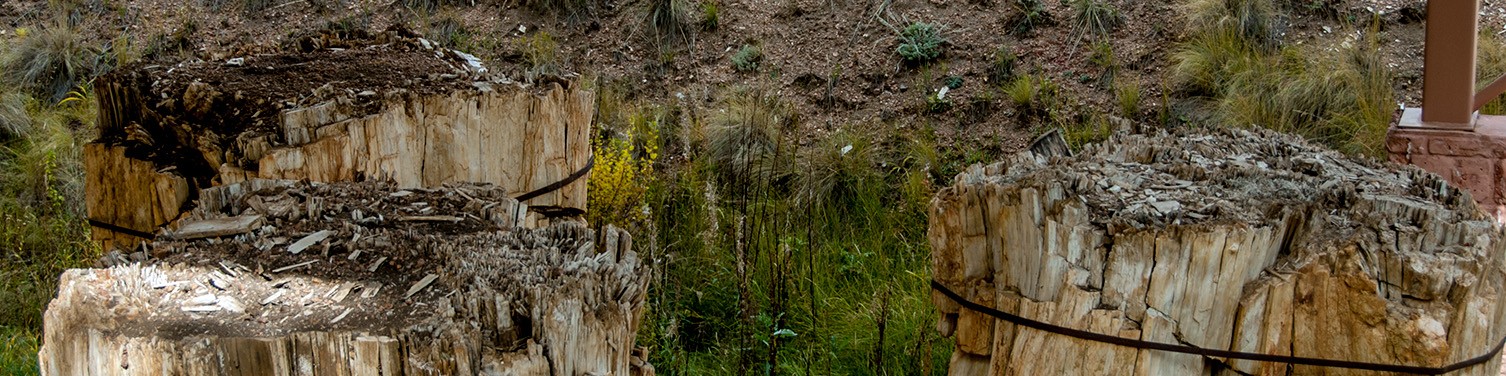
View of petrified logs at Piedra Chamana

Petrified log at Piedra ChamanaFlorissant Fossil Beds National Monument Paleontologist Dr. Herb Meyer will be giving a Curator’s Lunchtime Lecture at the Denver Museum of Nature & Science on August 1. This talk will cover the work Meyer and others have been doing to assist the citizens of Sexi, Peru, in conserving and developing a nearby Middle Eocene fossil forest, Piedra Chamana. Come learn about this developing partnership and research on the fossil forest and see beautiful photographs of a remote part of Peru!

Cross-section of petrified log at Piedra ChamanaWhat: Exploration and Conservation of the Sexi Petrified Forest in the Andes of Northern Peru
Who: Dr. Herb Meyer, Florissant Fossil Beds National Monument Paleontologist and DMNS Earth Sciences Research Associate
When: Wednesday, August 1, 12:15–1:15 p.m.
Where: Ricketson Auditorium, Denver Museum of Nature & Science
Cost: $5, free for DMNS members
Reservations: (303) 322-7009 or 1-800-925-2250

NO FOOD ALLOWED.

Photo Credits: Herb Meyer

March 31, 2007

Don’t forget about the flammulated owls!

Filed under: Biology, Ecology, Education, Lectures, Wildlife — The Friends of the Florissant Fossil Beds, Inc. @ 11:37 pm

Professor Brian Linkhart’s exciting flammulated owl talk is fast approaching–mark your calendar for 7:00 p.m. this Thursday, April 5, to learn about how fire affects these tiny owls.

Flammulated owlThe elusive flammulated owl (”flam”), the second smallest owl species in the U.S., lives in the ponderosa and aspen forests of the Colorado Front Range, forests shaped over centuries by frequent fire. But how have they fared in the face of catastrophic burns like the Hayman Fire, which burned the largest area in Colorado’s history?

Linkhart and his students have been studying flam populations in burned and unburned forests since 2002, trying to understand how owls and forest fire interact. Understanding the effects of fire on flams and other sensitive species may shape future pine forest conservation plans. An associate professor of biology at Colorado College, Linkhart teaches courses in ornithology, ecology, and field biology. He has studied forest raptors for over 25 years and is considered the country’s leading expert on flammulated owls. He has studied flams in Pike National Forest since 1981.

The talk will be held at Colorado College in the Tutt Science Center Lecture Hall, first floor. The event is free to the public, no reservations required.

-Melissa Barton

Photo Credit: USGS/Greg Lasley (click for larger image)

Older Posts »

Powered by WordPress