Artist’s reconstruction of the ancient Florissant forest by Rob Wood. NPS.
The July August issue of The Interpreter, a magazine for professional and volunteer interpretive educators, features as its cover story an article by Florissant Fossil Beds National Monument Volunteer Interpretive Specialist Heidi Bailey called “Are Your Stories Lost in Space? Interpret the Geography of a Place.”
In the article, Bailey uses Florissant as a vivid example of how telling the geographic as well as historical story of a place can enrich interpretation and engage visitors.
Bailey writes
Geography is about visualizing large spaces, getting acquainted with special places, and connecting to the Earth as a whole. The places and spaces around us are integral to our lives and should play a significant role in the stories we tell.
Bailey provides concrete activities that interpreters can use in their work. She can be contacted at hbailey@fossilbeds.org.
Thanks to partnerships with the Catamount Institute and other local organization, Colorado residents will have the chance to hear Richard Louv, author of the award-winning book Last Child in the Woods: Saving Our Children from Nature-Deficit Disorder and recipient of the 2008 Audubon Medal, speak at the Pikes Peak Center this October.
Tickets go on sale August 1 at 10 a.m. This event is part of No Child Left Inside Weekend, a collaboration between many Pikes Peak area parks and nature centers. For more information about scheduled activities and events as it becomes available, visit Florissant Fossil Beds National Monument’s No Child Left Inside website.
Who: Richard Louv, author of Last Child in the Woods: Saving Our Children from Nature-Deficit Disorder
When: 7:00 p.m., Friday, October 3, 2008 (doors open at 5:30 p.m. for exhibits)
Where: Pikes Peak Center, Colorado Springs, CO
For more information, email info@catamountinstitute.org or call 719-471-0910, Ext. 106. Tickets go on sale August 1 at 10 a.m. Adults $10, Educators $7, Students $5. Contact Tickets West at 719-520-SHOW.

Florissant Fossil Beds National Monument is beginning a long term oral history project. The project will use nearly $800.00 of professional audio recording equipment purchased by the Friends of the Florissant Fossils Beds.
The goal of this project is to record the stories related to the different aspects of the Monument’s history, which may include Native American history, settlers and the Hornbek Homestead, the commercial fossil and tourist operations, farming and ranching, the founding of the Monument, and the first few decades of the Monument’s history.
The new equipment allows the Monument to record conversations in person or over the phone so people who live far from the Monument may be interviewed. The stories will be recorded, transcribed, and stored. They will be available to researchers and portions of them may be used on the Monument’s website or in exhibits. The Monument staff would like to thank the Friends for their support in helping us preserve the stories and history of this amazing national park area.
Jack Williams, the second superintendent of the Monument, will be the first person to be interviewed. The Monument is compiling a list of additional people involved in the park’s history to interview. If you are one of these people or know someone who should be interviewed, please contact Jeff Wolin or Shawn Frizzell at the Monument at 719-748-3253 or flfo_information@nps.gov.
-Jeff Wolin, Lead Interpretive Ranger
Florissant Fossil Beds National Monument
Photo Credit: Melissa Barton

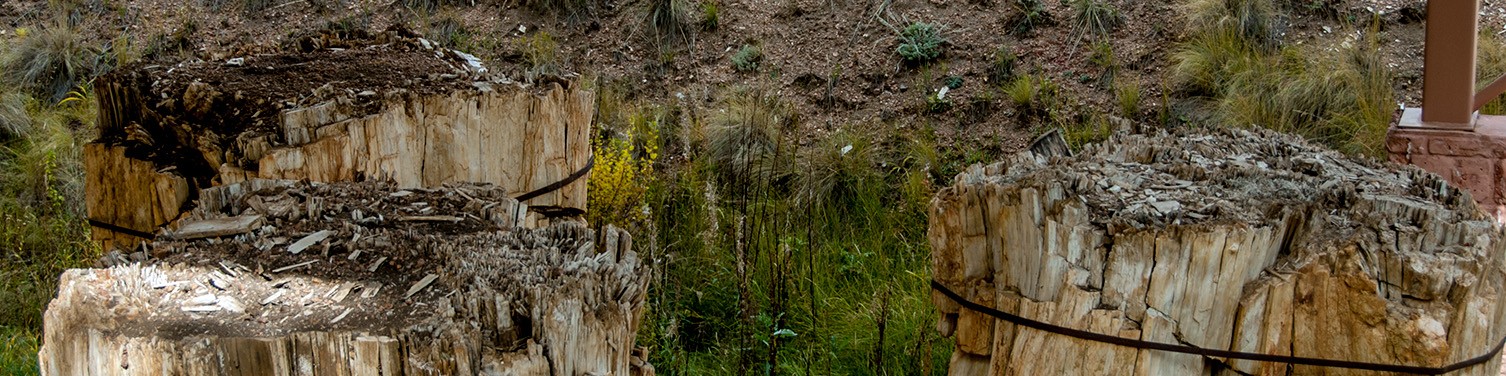
The Petrified Forest Loop winds through this mountain meadow, past several petrified redwood stumps, the Scudder Pit Interpretive Site, and a great view of the Hornbek Homestead and Crystal Peak.This summer
Florissant Fossil Beds National Monument obtained matching federal funds for a fund established by Dr. Hugo G. Rodeck, former director of the
University of Colorado Museum of Natural History and father of Jean Rodeck, former superintendent of Florissant Fossil Beds National Monument. Dr. Rodeck gave the money for to the
National Parks Foundation to invest with the intent of commemorating the paleontology of national parks.
Dr. Rodeck’s donation and the matching federal funds amount to $75,000 for designing and installing wayside panels along the Petrified Forest Loop (which includes the Big Stump and the Scudder Pit Interpretive Site), one of the park’s most popular trails. Jean Rodeck and Lead Interpretive Ranger Jeff Wolin will both be involved in designing the exhibits, which the park hopes will be installed by summer of 2009.
-Melissa Barton
Photo Credit: Melissa Barton

Kathy Salas (left) and Eva Lyon (right) show off their certificates with Dr. Herb Meyer, the park paleontologist.
Friday was the last day for summer paleontology interns Kathy Salas (University of Texas–Dallas) and Eva Lyon (College of Wooster). During their time here, they accomplished many projects for the park, including
- Overhauling the park’s Inventory & Monitoring Program and retaking all baseline data
- Assisting visiting researchers in the field and hosting the July 28-29 paleontology seminar
- Collecting fossils in South Park for a comparative research project
- Writing site bulletins about the park’s fossils and about resource management and research in the park (available soon in the Visitor Center)
- Assisting interpretive staff with exhibit assembly and other projects
- A complete inventory of the park’s herbarium (modern plant) collection
Summer interns help the park accomplish vital work and we are always sorry to see them go. Best of luck to Kathy and Eva in their future endeavors. The park thanks the Friends of the Florissant Fossil Beds, Inc. and the Geological Society of America for making many internships possible over the years.