The Friends of the Florissant Fossil Beds

April 7, 2008

“Paleontology of the Upper Eocene Florissant Formation, Colorado” available from GSA bookstore

Filed under: Geology, History, Paleontology, Research, Science — The Friends of the Florissant Fossil Beds, Inc. @ 7:41 pm

Cover of Paleontology of the Upper Eocene Florissant Formation, Colorado

Paleontology of the Upper Eocene Florissant Formation, Colorado (ISBN 9780813724355), a Geological Society of America special paper, is now available from the GSA Bookstore ($42 GSA members, $60 nonmembers).

This 177-page volume, edited by Florissant Fossil Beds National Monument paleontologist Dr. Herbert W. Meyer and University of Colorado Museum of Natural History professor Dr. Dena M. Smith, collects 11 papers on research, resource management, and history at the Fossil Beds.

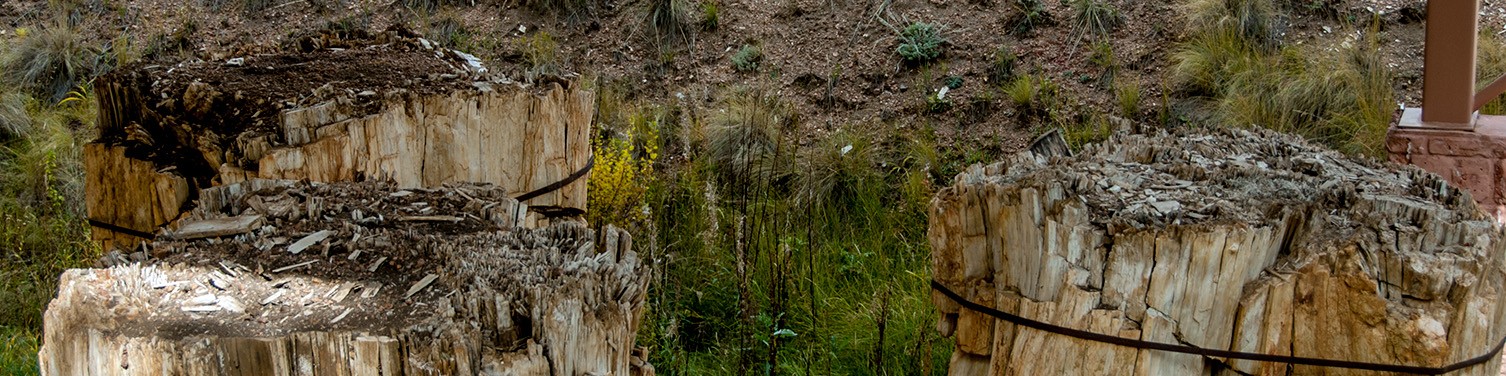
These papers include, among others a history of the paleontological study of the site; new models for the role of biofilms in fossil preservation; plant-insect associations during the Eocene; a summary of the mammalian fauna; the mineralogical preservation of the fossil woods and conservation strategies for the petrified forest; and the development of a new database to compile a complete inventory of the fossils and their taxonomy.

While aimed at a scientific audience, this volume is a must-have for the library of any serious enthusiast of the Florissant fossils.

February 15, 2008

Florissant Fossil Beds National Monument launches oral history project

Filed under: History, News, People — The Friends of the Florissant Fossil Beds, Inc. @ 12:05 am

Florissant Fossil Beds National Monument Visitor Center

Florissant Fossil Beds National Monument is beginning a long term oral history project. The project will use nearly $800.00 of professional audio recording equipment purchased by the Friends of the Florissant Fossils Beds.

The goal of this project is to record the stories related to the different aspects of the Monument’s history, which may include Native American history, settlers and the Hornbek Homestead, the commercial fossil and tourist operations, farming and ranching, the founding of the Monument, and the first few decades of the Monument’s history.

The new equipment allows the Monument to record conversations in person or over the phone so people who live far from the Monument may be interviewed. The stories will be recorded, transcribed, and stored. They will be available to researchers and portions of them may be used on the Monument’s website or in exhibits. The Monument staff would like to thank the Friends for their support in helping us preserve the stories and history of this amazing national park area.

Jack Williams, the second superintendent of the Monument, will be the first person to be interviewed. The Monument is compiling a list of additional people involved in the park’s history to interview. If you are one of these people or know someone who should be interviewed, please contact Jeff Wolin or Shawn Frizzell at the Monument at 719-748-3253 or flfo_information@nps.gov.

-Jeff Wolin, Lead Interpretive Ranger
Florissant Fossil Beds National Monument

Photo Credit: Melissa Barton

August 31, 2007

Driving the Gold Belt Byway: Indian Springs Trace Fossil Site and Phantom Canyon (Stops 19-21)

Filed under: Activities, Biology, Geology, Gold Belt Byway, History, Paleontology, Science, Travel — The Friends of the Florissant Fossil Beds, Inc. @ 12:00 pm

Our last major stop for the day on the Gold Belt Byway was Indian Springs Ranch, a ranch and campsite owned by the Thorson Family. The Indian Springs Trace Fossil Site is a National Natural Landmark (NNL) protected by the federal government, but it is owned by the Thorson Family and you must have permission and be accompanied by a family member to visit the site. Tours may be arranged by calling ahead.

Photo of chinchweed flowersCarly Thorson, who led our tour, is very knowledgable about the many plants of the ranch, as well as its history. The flower to the left is chinchweed (Pectis papposa), a lemony-scented plant with several medicinal uses. We also saw a petroglyph and some historical sites, including the cabin used by Wild Bill McKinney of Quantrill’s Raiders.

Photo of National Natural Landmark markerThe Middle Ordovician (c. 450 million years old) trace fossils were found by Thorson’s father, Bennie C. Thorson, who worked the site for five field seasons with now-retired Colorado College professor William A. Fischer. The site was designated as an NNL in 1979. The voluntary NNL program, administered by the National Park Service, provides a way to recognize and protect important natural resources on any type of land, including private, local, municipal, state, and federal. Not all NNLs are open to the public, and many others require landowner permission to visit.

Photo of Indian Springs Trace Fossil SiteThe Indian Springs Trace Fossil Site consists of a shallow excavation exposing a single bed of the Harding Sandstone, representing an “instant” in geologic time. The quarry is 16-18 feet above the base of the Harding. Much of the overlying sandstone has been eroded at this locality. The Thorsons keep the site covered to protect the exposed trace fossils, which remain in situ according to family policy.

Photo of sea scorpion trackBody fossils are rare in the Harding, including at Indian Springs, but trace fossils are abundant. Bony plates from ostracoderms (armored fish) and conodont elements are found there, but the site’s primary significance lies in its spectacular trace fossils from various animals moving across the Ordovician seafloor. At right, you can see a track left by a sea scorpion (eurypterid).

Photo of ostracoderm feeding traceOstracoderms were some of the earliest vertebrates. They lacked jaws, but were covered with bony plates, and were also the first organisms to use gills exclusively for respiration. Ostracoderms were bottom-feeders and probably relatively slow-moving. Here you can see a feeding trail of an ostracoderm. The close spacing of the feeding marks indicates that food was abundant on the Ordovician seafloor.

Photo of horseshoe crab feeding traceTracks of several species of horseshoe crabs are quite common. The feeding traces typically curve either left or right according to the species. Horseshoe crabs are not actually crabs–they are more closely related to sea scorpions, and distantly related to the spiders–and they have evolved little since they first appeared in the fossil record. They are tolerant of harsh environments and protected by their sturdy shell.

Photo of ostracoderm feeding and predator attack tracesThis trace fossil shows an abruptly ended ostracoderm feeding trail, as the fish became a meal for a predator. The preservation of interactions like these is one reason the Indian Springs fossil site is so important. Other trace fossils at this site include tracks from trilobites, merostomes, and polychaete worms.

After Indian Springs, we drove back through Phantom Canyon (Stops 19-20), the location of several historical railroad sites, as well as more outcrops of Precambrian granodioriate and metamorphic schist and quartzite. We didn’t manage all of the stops on the Gold Belt Byway–that would take at least two days–but we had a great field trip.

-Melissa Barton

Photo Credits: Melissa Barton

Geologic Guidebook to the Gold Belt Byway, Colorado, by Thomas W. Henry, Emmett Evanoff, Daniel A. Grenard, Herbert W. Meyer, and David M. Vardiman (Gold Belt Tour Scenic and Historic Byway Association, 2004), is available at the Florissant Fossil Beds National Monument Visitor Center for $19.95 plus tax.

More Gold Belt Byway Posts:

August 18, 2007

Culturally Modified Trees: Legacy of the Ute Tribes
Filed under: Culture, History — The Friends of the Florissant Fossil Beds, Inc. @ 12:00 pm

This article originally appeared on the Friends website as “Living Archaeology: Culturally Scarred Trees, Legacy of the Ute Tribes.” “Culturally modified trees” is the currently accepted term, and also includes trees that have been deliberately bent or otherwise shaped without bark peeling.

The park is currently considering plans to conduct research on culturally modified trees within the park.

Culturally Modified Trees: Legacy of the Ute Tribes

Steven Wade Veatch

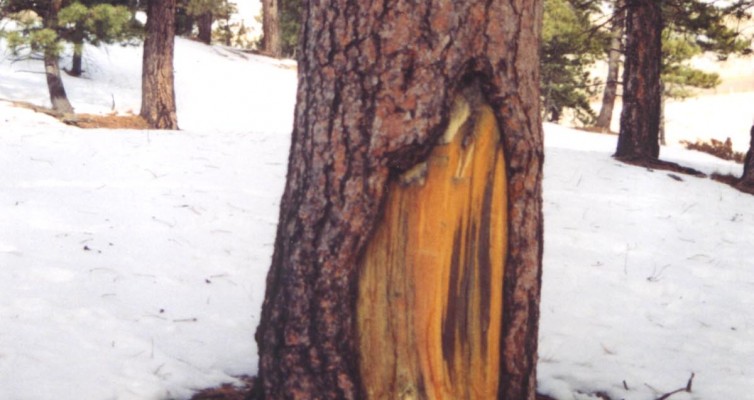
For centuries, Native Americans have peeled away the outer bark of ponderosa pine (Pinus ponderosa) trees to obtain the tree’s soft inner bark (cambium layer) for food and medicine. In addition to using the inner layer of bark for food and medicinal tea, the Utes used the sap to waterproof containers and the bark to make cradleboards. Peeling leaves a permanent scar on the tree.

Today these centuries-old trees, known as culturally modified or peeled trees, mark the presence of Ute Indians who once lived in the Pikes Peak region.

A culturally modified trees is defined as “a tree that has been altered by native people as part of their traditional use of the forests” (Styrd, 1998). Culturally modified trees are an important part of the archaeological and historical record of the Utes.

Culturally modified trees provide information about Ute lifeways, disclose areas of occupation, mark paths the Utes followed, and indicate food resources.

tree1.jpgCulturally modified tree. Note ragged edge at top, probably from the bark being cut with sharpened stone and pulled down. Photo: Jo Beckwith.

When peeling trees, the Utes would make a horizontal cut through the bark on the outside of the tree with a hatchet or sharp stone. Hatchets made straight lines while a sharp stone left jagged lines. After making a cut on the tree, a sharpened branch or pole was placed under the cut and the bark was pried away from the tree. Strips of inner bark were then removed from the outer bark with a scraper.

tree2.jpgCulturally modified tree near Guffey, Colorado. Healing tissue generally obscures tool marks. Photo: Jo Beckwith.

The oval or rectangular-shaped scars left by the Utes on ponderosa pine trees can be very large–up to eight feet long and two feet wide.

Not all scars found on trees were made by Utes. Forest fires leave a triangular-shaped scar with the widest edge along the bottom of the tree. Scars caused by lightning are long and thin, extending along the length of the tree. At times lightning scars spiral around the tree. Animals like elk, porcupine, and bear also leave scars, which are often visible.

Tree-ring dating conducted by Golden archaeologist Marilyn Martorano at several Colorado sites shows that the Utes peeled most of the culturally scarred trees between 1815 and 1875 (Martorano, 1981). This period was one of profound change in Colorado. First trappers arrived, then miners came searching for gold, and finally farmers and ranchers followed–all pushing the Utes from their land. As more people swarmed into the region, food became scarce. This led the Utes to peel trees for food at a greater rate.

tree3.jpgCulturally modified tree, Florissant Fossil Beds National Monument, Florissant, Colorado. The width and length of these scars vary. NPS Photo.

There are at least 17 culturally modified trees in the Blue Mountain area of Pike National Forest, at least 26 modified trees in Florissant Fossil Beds National Monument, and a number of modified trees over 200 years old in the Manitou Experimental Forest north of Woodland Park.Although the National Historic Preservation Act protects these trees from human activity, this important archaeological resource is quickly disappearing as these trees begin to die from natural causes. The maximum lifespan of the ponderosa pine tree is between 300 to 600 years, so further research is vitally important before this archeological information is lost forever.

tree4.jpgCulturally modified tree in a ponderosa pine forest, Florissant Fossil Beds National Monument. The soft inner bark of the tree is high in calcium. Photo: D. Atkins.

References

Martorano, M.A., 1981. Scarred Ponderosa Pine Trees Reflecting Cultural Utilization of Bark. Unpublished M.A. thesis, Department of Anthropology, Colorado State University, Fort Collins, Colorado.

Styrd, A., 1998. Culturally Scarred Trees of British Columbia: A Handbook for the Identification and Recording of Culturally Scarred Trees. Arcas Consulting Archaeologists, Ltd. B.C. Ministry of Forests.

August 5, 2007

Cockerell’s Contributions Celebrated

Filed under: Events, History, Paleontology, People, Science — The Friends of the Florissant Fossil Beds, Inc. @ 9:30 am

In honor of the second year of the centennial of T.D.A. Cockerell’s expeditions to Florissant (1906-1908 / 2006-2008), we’re reprinting an article (with some additional photos) about last year’s celebrations at the University of Colorado Museum and Florissant Fossil Beds National Monument. This article first appeared in the Fall 2006 issue of the Friends newsletter. Ask at the Visitor Center desk this summer for the Cockerell site bulletin to learn more about the scientific history of the Florissant fossil beds.

Cockerell’s Contributions Celebrated

Melissa Barton

Naturalist Theodore Dru Alison Cockerell was one of the most prolific researchers to collect at Florissant. He described hundreds of species, many of which still stand today. T.D.A. Cockerell’s interests were broad: he studied plants, insects, and mollusks at Florissant, although his particular interest was in the fossil insects.

This summer marked the centennial of Cockerell’s first collecting expedition to Florissant in the summer of 1906. The expeditions of 1906-1908 collected many of the most spectacular and scientifically interesting fossils to come from the lake shales of Florissant. Today these specimens are scattered through the collections of museums across the country and in Europe, although many remain at the University of Colorado Museum.

(more…)

Older Posts »

Powered by WordPress