The Friends of the Florissant Fossil Beds

October 19, 2008

Oldest North American mole found at Florissant
Filed under: Paleontology, Research, Science, Species Spotlight — The Friends of the Florissant Fossil Beds, Inc. @ 9:53 pm

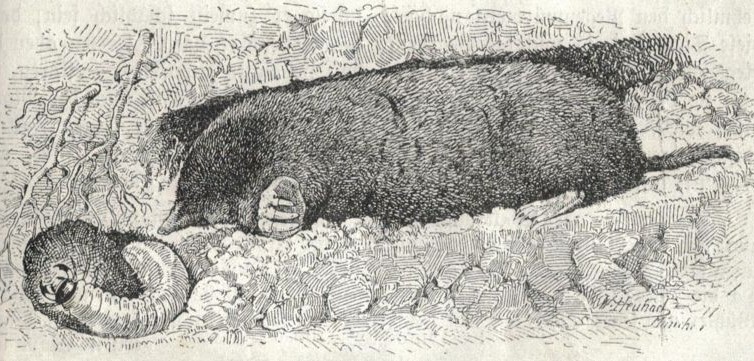
Zoological illustraction of European mole by Walter Heubach

Despite over 120 years of fossil discoveries, the Florissant Fossil Beds are still producing new discoveries.

A new genus and species of fossil mole has been described from Florissant, published in September 2007 in Acta Palaeontologica Polonica. Karen Lloyd, who graduated in 2007 from the University of Colorado with an M.S. in Museum and Field Studies, discovered a partial jaw with three teeth among material collected from Florissant Fossil Beds National Monument.

Lloyd named the fossil mole Oreotalpa florissantensis, which means “mountain mole from Florissant” (oreo = mountain, talpa = mole). In addition to representing a new genus and species, Oreotalpa is the first evidence that moles lived around ancient Lake Florissant, as well as the oldest known specimen of a mole from North America. While moles were previously believed to have originated in Europe, Oreotalpa suggests the possibility of a North American origin for moles.

Research since 2003 by Lloyd, her advisor Dr. Jaelyn Eberle, and another Museum and Field Studies graduate and former park intern, Marie Worley-Georg, has more than tripled the number of known fossil mammals from Florissant.

The list now includes rodents (relatives of squirrels, mice, and the “mountain beaver” Aplodontia), rabbits, shrews and other insectivores, the small three-toed horse Mesohippus, deer-like Leptomeryx, sheep-sized oreodonts, a pigmy opossum, a rhinoceros-like brontothere, and a tapir-like ancestor of the rhinoceroses. Although less abundant at Florissant than fossil plants and insects, mammals are an important part of the ecological picture of ancient Lake Florissant.

You can read an abstract and download a copy of Lloyd and Eberle’s paper at Acta Palaeontologica Polonica.

-Melissa Barton

Image Credit: Walter Heubach (German, 1865-1923) (European mole, Talpa europaea)

February 12, 2008

Species Spotlight: Ponderosa Pine

Filed under: Biology, Ecology, Science, Species Spotlight — The Friends of the Florissant Fossil Beds, Inc. @ 12:00 pm

Read former Florissant Fossil Beds National Monument intern J.J. Huie’s full article in the Spring 2008 Friends newsletter!

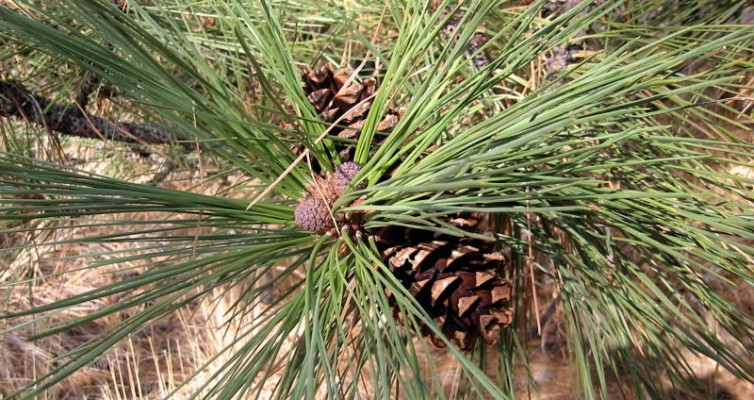
Ponderosa pine cones, photographer Walter Siegmund

With Deep Roots in Colorado: The Ponderosa Pine

by J.J. Huie

I like running in Colorado when the sound of my breathing is drowned out by a wind so violent it causes the arms of the ponderosa pines (Pinus ponderosa) to thrash about wildly. Hundreds of miles from the Pacific, in the foothills next to Rampart Range near Colorado Springs, I feel like I’m sailing through an ocean storm. In crossing this ocean, however, there is no salty scent or giant, looming swells; instead, I have the waving motion of the ponderosas and the rich aroma they exude.

In Colorado, the ponderosa pine ecosystem can be found at an elevation range of 5,600 feet to 9,000 feet on both sides of the Continental Divide, with ponderosas dominating on sunny, south-facing slopes. Throughout much of the elevation range of the ponderosa, Douglas-firs predominate on the shadier, north-facing slopes. Direct solar radiation is critical to the ponderosa, which germinates best on soils with unobstructed sunlight. Standing close to a mature tree, I enjoy the scent of vanilla that the orange-brown bark gives off as it’s warmed by the sun.

A distinctive feature of ponderosas is their long needles (up to 7 inches in length), which come in bundles of two or three needles. The needles of ponderosas are the longest among conifers in Colorado. Some ponderosas are among the largest trees in the Southern Rockies (the area from southern Wyoming through Colorado to northern New Mexico), growing up to 150 feet in height and more than 3 feet in diameter.

Mature trees usually have rounded crowns, while the oldest trees can have flat-topped crowns, unlike most other conifer species. Mature cones are globe shaped and can be up to 6 inches long; each of the cone’s thick scales is tipped with a sharp bristle.

(more…)

October 9, 2007

Species Spotlight: Wapiti or American Elk

Filed under: Biology, Ecology, Species Spotlight — The Friends of the Florissant Fossil Beds, Inc. @ 12:00 pm

Photo of American elk at Yellowstone National Park

It’s hard to forget the eerie sound of an American bull elk bugling–the sound is almost completely unlike a bugle, but rather a high, unearthly wail. Elk bugling is a common sound at Florissant Fossil Beds National Monument in the fall, when elk rut (seek mates).

American elk (Cervus canadensis*), which once numbered 10 million in North America and which lived in grasslands from coast to coast, today are mostly confined to last remaining wild spaces in the mountains. In Colorado, according to seasonal park ranger Harv Burman, wildland is developed at a rate of 4 acres per hour. That doesn’t leave much space for the elk, but in September and early October you still have a good chance of hearing or seeing elk at the park, particularly at the south end and along Lower Twin Rock Road.

Elk use tree saplings to rub the velvet from their antlersDuring the rut, or mating season, cow elk focus on eating. They need the fuel to carry calves through the winter. The bulls, however, are often too busy to eat–the successful are busy gathering and keeping harems of 10-15 cows. They shed the velvet from their antlers in August, and polish them on trees. Struggles between males usually involve only pushing and shoving, and the antlers are more for display than combat. The bugling is also a warning to other males.

The Rocky Mountain elk (C. canadensis nelsoni) is the largest of the North American elk and the largest of the red deer species worldwide. In Europe, “elk” refers to the American moose (Alces alces), and “red deer” to C. elaphus, although European and Asian red deer are much smaller than American elk. There has been a largely unsuccessful push in North America to call C. canadensis by its Shawnee name, “wapiti,” meaning “white rump.” Like “buffalo” for the American bison (Bison bison), the name “elk” has centuries of inertia behind it.

Park Ranger Harv Burman giving an elk talkSigns of elk–tracks, scat, scarred aspens, and broken ponderosa saplings–are common sights in the Front Range, but elk themselves are more elusive. Hundreds of elk graze and mate in the park in fall. In September and early October, park rangers at Florissant Fossil Beds National Monument lead evening programs to listen and look for elk. The chances of hearing the elk are very good, but elk sightings occur less often.

Many quaking aspen (Populus tremuloides) trunks in the park are scarred from elk eating the bark. Aspen bark is photosynthetic and a favorite of elk, especially in winter when nutritious grazing is hard to come by. Unfortunately for the aspens, elk chew makes them vulnerable to infection. Canker-invading fungi such as sooty-bark canker (Encoelia pruinosa) attack the trees, often killing them. Because aspens stands are “clones” with a common root system, fungus spreads rapidly from tree to tree. Sometimes a combination of overgrazing and fungus can kill an entire aspen clone.

The last elk walk this year will be on October 13, but you can always visit the park to listen and look for elk yourself. Nearby Mueller State Park is also a good place to spot elk.

ELK-SPOTTING TIPS

  • Early morning and late evening in fall are the best times to see elk in the Front Range.
  • Elk are color-blind, so it doesn’t matter what you wear, but try to stay in the cover of the trees.
  • If you spot a herd, approach quietly and slowly from downwind. Elk have excellent senses of hearing and smell.
  • Stop and listen frequently for the distinctive wailing bugles of the bulls. Elk herds can travel and change direction quickly.
  • If you want a virtual guarantee of seeing elk and don’t mind them being practically tame, visit Rocky Mountain National Park. In this area, elk are so used to humans they have become pests.

-Melissa Barton

Photo Credits: PDPhoto.org/Jon Sullivan (elk at Yellowstone), Melissa Barton (broken sapling and Ranger Burman giving a talk)

*Some biologists classify American elk as belonging to the same species as European and Asian red deer, C. elaphus. Recent genetic studies suggest that American elk belong to a different species from red deer. Further studies will clarify the relationship of different species and subspecies of red deer and American elk (return to article).

August 21, 2007

Species Spotlight: Mountain Mahogany

Filed under: Biology, Paleontology, Species Spotlight — The Friends of the Florissant Fossil Beds, Inc. @ 12:00 pm

Photo of modern mountain mahogany seed cluster

Seed clusters of living mountain mahogany, Indian Springs Ranch, Colorado.

Mountain mahogany (Cercocarpus) is a small genus of deciduous shrubs or small trees, currently placed in the rose family (not closely related to true mahoganies, in the Meliaceae family). In addition to growing throughout the Rocky Mountain region today, mountain mahogany is a relatively common Tertiary (65 to 1.8 million years ago, the time between the extinction of the dinosaurs and the first Ice Age) fossil found in the Florissant and Antero Formations, as well as at Creede, Webber Lake in the Sierra Nevada of California, the Desert Peak Formation of Nevada, Oligocene sediments in Mexico, and many other localities.

Photo of mountain mahogany fossil from the Antero FormationMountain mahogany seeds are more common than leaves in the Florissant Formation (34.07 million years old), although the numerous hairs of the modern seeds (above) are not evident–seeds are generally preserved as a small oval seed with a long curling tail. In certain localities in the nearby Antero Formation (~33.76 million years old), mountain mahogany leaves are the most abundant fossil. At left you can see the well-preserved part and counterpart of a mountain mahogany leaf from the Antero.

Photo of fossil mountain mahogany and pine from the Antero FormationWe haven’t found any mountain mahogany seeds like the ones from Florissant in the Antero yet, only leaves. Further study will show whether the Antero mountain mahogany more closely resembles the species from Florissant or the species from the Oligocene Creede flora, which grew in a much colder climate than that of ancient Lake Florissant.

-Melissa Barton

Photo Credits: Melissa Barton

August 16, 2007

Park fights to stop spread of yellow sweetclover

Filed under: Conservation, Ecology, Park Changes, Resource Management, Species Spotlight — The Friends of the Florissant Fossil Beds, Inc. @ 12:00 pm

Interp intern Lindsey Stecker pulling sweetclover

Student Conservation Association intern Lindsey Stecker pulling sweetclover.

Yellow sweetcloverYellow sweetclover (Melilotus officinalis), an introduced European plant, grows profusely along roadways, trails, and in other disturbed areas throughout the plains and montane regions of North America, including Florissant Fossil Beds National Monument. Sweetclover is a hardy biennial that is used as fodder for livestock and for producing clover honey. Outside of cultivation, sweetclover can out-compete native plants, as well as overrun pastureland.  Sweetclover is aggressive and difficult to eradicate, and seeds can remain viable in the soil for up to 30 years.

Yellow sweetclover growing along roadsideYellow sweetclover bushes can grow from 2 to 5 feet tall and have strong taproots. At right, sweetclover grows densely along the road to the Visitor Center. Park staff, particularly Student Conservation Association interpretive intern Lindsey Stecker (Boston University) and Chief Ranger Rick Wilson, have been working hard to control the spread of sweetclover this summer.

-Melissa Barton

Photo Credits: Melissa Barton

Older Posts »

Powered by WordPress